Our Objective
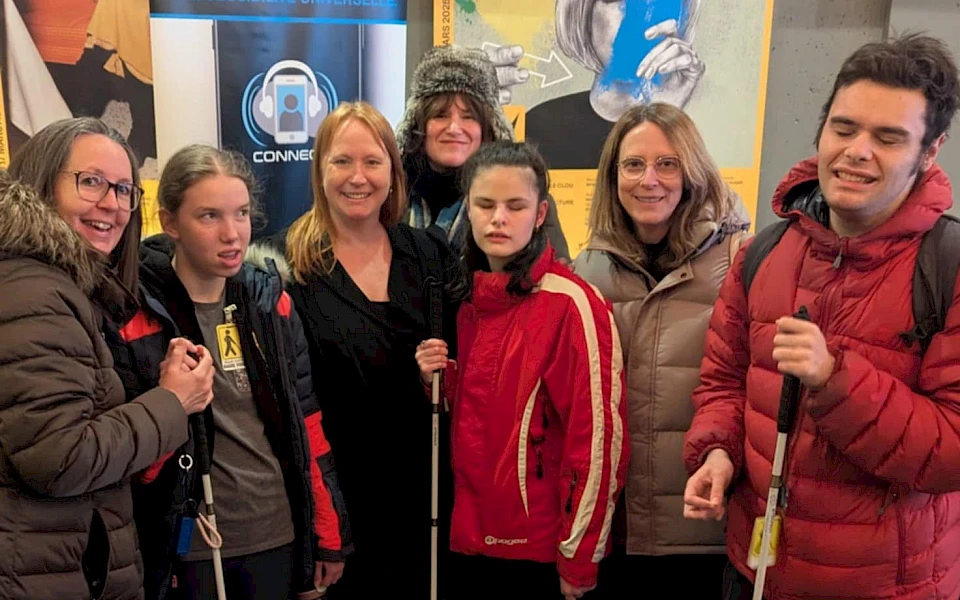
We want to help cultural institutions make their productions accessible to an audience that is too often marginalized. To achieve this, we work closely with teams that produce theatrical or opera works in order to write a high-quality audio descriptive script. During the live show presentation, the team of volunteers travels to the venue with a Sennheiser broadcasting system. Blind, visually impaired, and hearing impaired spectators are invited to download our app on their phones. Once they are sitting comfortably in the theater, they can listen to the play or opera with the aid of audio description, or access the amplified audio of the dialogue directly in their ear buds or hearing aids. When their faces light up, we have reached our goal!
Connec-T’s Origin
In January 2012, Sylvain Noël’s sister Sylvie learns that she has an invasive mass growing in her brain. The surgery to remove it succeeds, but renders Sylvie blind. Over the next two years, Sylvain accompanies his sister on her travels and to various events. As a result, Sylvain notes the lack of adaptation measures to meet the needs of blind and partially sighted people in the field of visual culture. It is his desire to allow his sister to “see with her ears” that Sylvain creates Connec-T.
Sylvain wants to find the technology that will allow the public broadcast of live audio description for blind and visually impaired spectators. During his research, he finds the Sennheiser Mobile Connect broadcast system. Thanks to the financial support of the Conférence régionale des élus, Sylvain acquires this unique broadcasting system as it can be installed in any theatre. The audio description of the show, sets, costumes and actions taking place on stage, as well as the actors’ voices, are routed to the Sennheiser system, and are broadcast via Wifi network to the receiving devices (iOS or Android), which are themselves connected to the Mobile Connect app.
Blind and visually impaired spectators are delighted with the service offered by Connect-T. However, it is still difficult to convince some producers and performance venues of the need to make their productions accessible.